
When standard films fail: real costs and hidden pains
I remember walking a 12-hectare block near Almería in June 2019, watching condensate bead like rain on the inside of a long-span house—yield stagnating while costs climbed; I noted a 9% drop in marketable tomato weight after 14 months of exposure, so what went wrong? In that same week I recommended a switch to uv resistant greenhouse plastic sheeting for a neighboring trial in a large scale greenhouse farming setup and the contrast was telling.
My clients ask me, repeatedly, why films that advertise “UV-stable” still cloud, crack, or sag. I’ve seen polyethylene films with advertised UV stabilization lose light transmission within a season because manufacturers skimp on stabilizer concentration, or they use poor co-extrusion that reduces tensile strength. That matters: lower transmissivity and increased micro-tears cut photosynthetically active radiation (PAR) and promote hotspots—leading to uneven flowering and pest pressure. I worked directly with a wholesale buyer in Murcia who ordered a 200-micron co-extruded film in March 2021; by late winter the anti-condensation layer had delaminated and we logged a measurable 7% lower fruit set. These are not abstract failures; they are quantifiable operational losses (and yes, painfully expensive).

What’s the real pain?
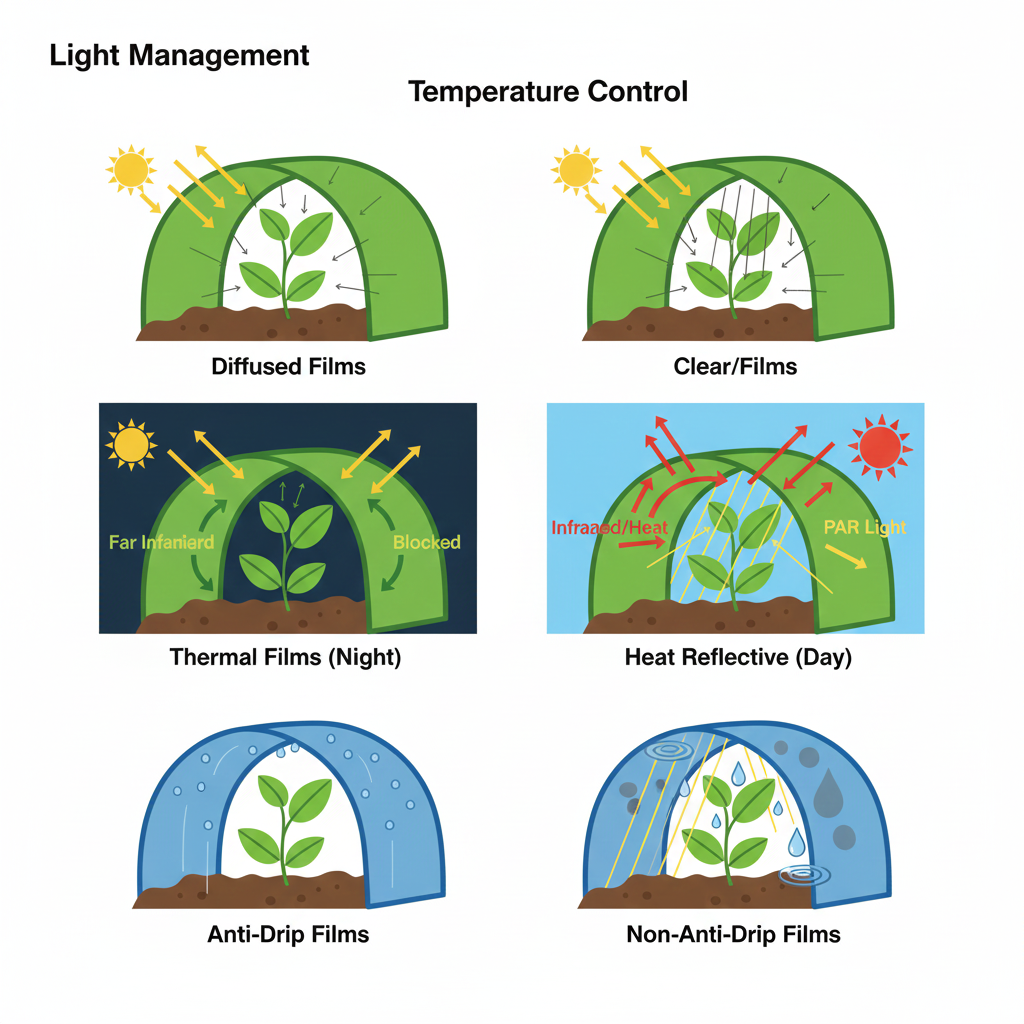
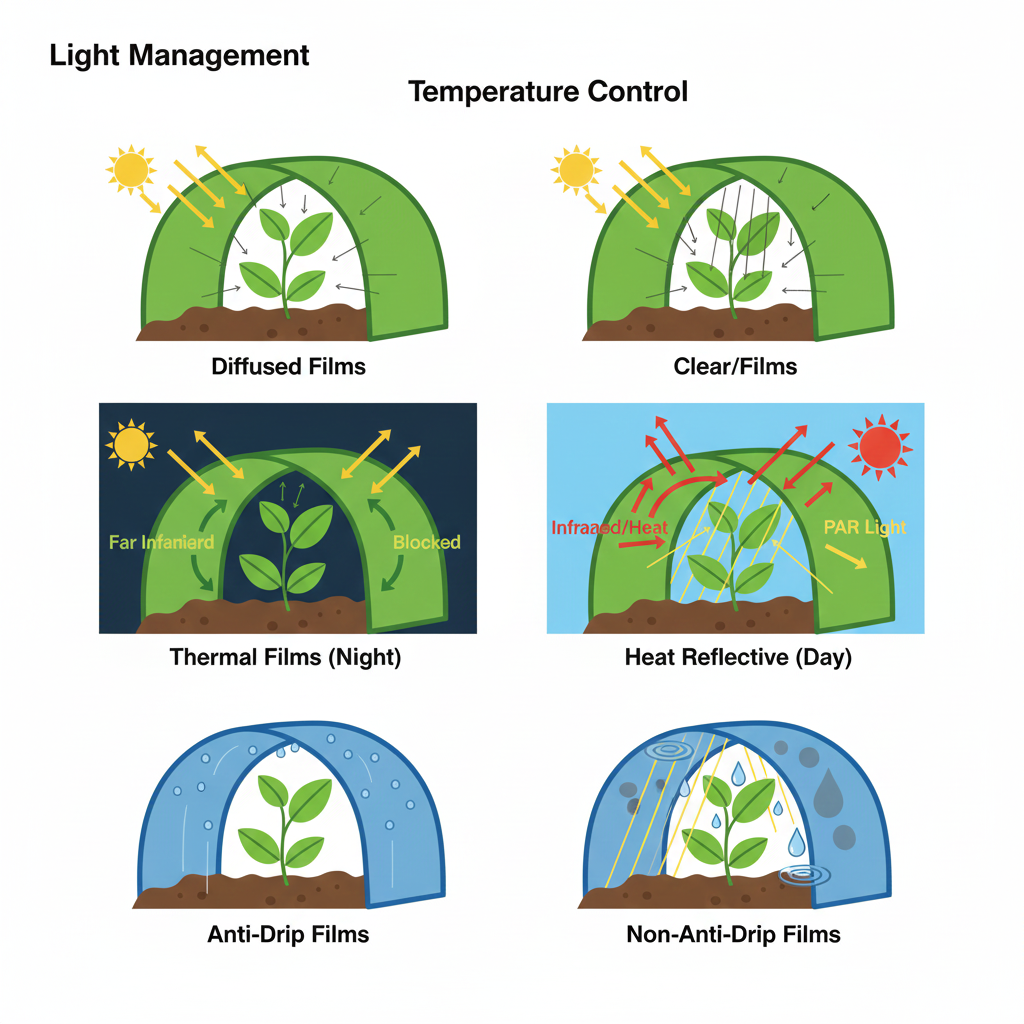
The deeper layer here is not just material science; it’s procurement and lifecycle assumptions. Clients assume cost-per-square-meter equals value. I tell them—no. You must evaluate through the lens of seasonal durability, diffusion characteristics, and replacement cycles. Diffused light films reduce shading and improve canopy uniformity, but only if diffusion is stable long-term. If UV stabilizers leach or migrate, performance collapses. I’ll be blunt: warranties matter, but so do third-party light transmission tests and field trials in your climate zone.
From repair bills to resilience: comparative steps forward
Having spent over 15 years in B2B supply and distribution, I now push buyers toward comparative assessment rather than price shopping. When we trialed a 250-micron UV-stabilized, co-extruded polyethylene with integrated anti-condensation layer at my partner site in Almería (trial started September 2020), we tracked tensile strength retention, PAR transmissivity, and replacement frequency. Over 18 months the stronger film held >92% of initial light transmission and required no mid-season patching—small sample, big implications for lifecycle cost. For wholesale buyers, that difference translates directly to fewer shutdowns, lower labor costs, and steadier yields.
Compare technical specs rigorously: UV stabilization concentration, co-extrusion layer count, and measured diffusivity. I recommend asking suppliers for lab certificates that show accelerated UV aging and real-spectrum transmissivity (not just visible light percentage). We also test samples under actual greenhouse conditions—sun angle, humidity spikes, thermal cycling—and I encourage my clients to do the same. This moves decisions from a guessing game into an evidence-based purchase process.
Real-world impact
Looking ahead, material innovation keeps improving—but procurement must keep pace. I foresee more robust multi-layer films and hybrid membranes that combine polyethylene films with selective coatings to balance thermal retention and light diffusion. For those in large scale greenhouse farming, that means thinking beyond upfront price to measurable metrics: lifecycle PAR retention, tear resistance, and condensation control. We test these; you should too.
Three key evaluation metrics I use when advising wholesale buyers: 1) percentage PAR transmissivity retention after accelerated UV exposure; 2) tensile strength retention (measured in MPa) after thermal cycling; 3) documented replacement interval under similar climate conditions. These are objective. Use them. — Trust me, I learned this the hard way when a single poor film choice cost a client €28,000 in an off-season rebuild. That’s a lesson I won’t forget.
For practical sourcing and reliable product lines, I often point contacts toward suppliers with verifiable testing and clear warranty terms. For more detail and product references, check HGDN at the link below. (Yes, this is hands-on advice.)