

The problem: clinical complexity versus constrained systems
Hospital wards and home-care settings face a persistent mismatch: clinicians need precise control of airflow and pressure, while many ventilator designs prioritize feature lists over durability and usability. During the spring of 2020, New York City hospitals exposed how fragile that balance can be—surge demand revealed failures in supply chains, interfaces, and staff training. Engineers and clinicians responded with rapid retrofits and simpler setups, including makeshift use of a cpap device when conventional ventilators were unavailable. The core problem remains: devices must deliver reliable positive airway pressure and predictable tidal volume across diverse patients without imposing unsustainable maintenance or energy burdens.

Why design choices matter for patients and systems
Design is not cosmetic. Choices about ventilator modes, sensor placement, and user interface change clinical workflows and outcomes. A mismatched interface increases leak and patient-ventilator asynchrony; poorly chosen PEEP control ramps complicate oxygenation management. For home users, the distinction between a cpap device, a bi-level mode, and a full mechanical ventilator matters in training and safety. The right balance reduces rehospitalization and shortens clinician time per patient—concrete metrics that hospitals can measure and manage.
Practical patterns for sustainable ventilator design
Actionable design priorities are straightforward and measurable:
– Modularity: separate core pneumatic components from electronics so parts can be swapped without specialized tools.
– Energy efficiency: optimize blowers and control loops to reduce power draw, enabling longer operation on backup power and lower lifecycle emissions.
– Usability: clear, consistent controls and a minimal, guided setup for common modes cut training time. Include auto-CPAP-like simplicity for straightforward support, with escalation paths to full ventilator modes.
– Maintainability: standardize filters, tubing, and connectors to reduce inventory complexity internationally.
– Telemetry: basic remote monitoring for alarms and adherence reduces in-person checks while preserving patient safety.
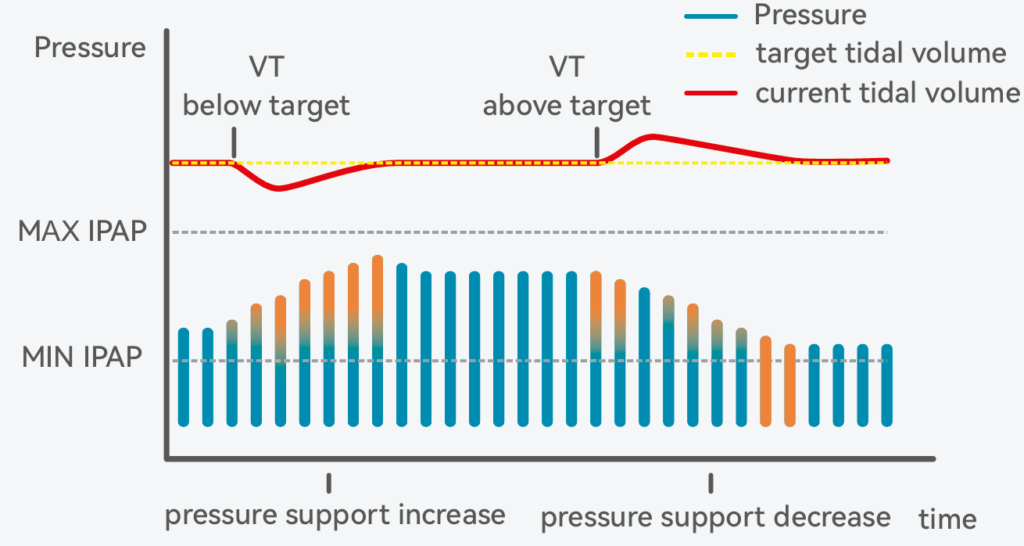
These choices address both clinical safety and sustainable operation—fewer replacements, fewer trips, less waste. The emphasis is analytical; design trade-offs should be quantified and tracked.
Implementation traps to avoid
Teams often repeat a handful of mistakes. First, overloading the UI with every possible ventilator mode; clinicians then ignore advanced settings. Second, assuming a single interface works for neonatal to adult patients—tidal volume scaling must be explicit. Third, neglecting supply-chain resilience for filters and single-use interfaces. During rapid deployments, teams introduced quick fixes that later complicated certification and maintenance—an avoidable cost. A short reminder: user manuals are not substitutes for intuitive design—training supplements, not replaces, good ergonomics.
Operational teardown: what to measure
When you evaluate devices, focus on three operational metrics that matter in the real world: mean time between failures (MTBF), power consumption under typical loads, and the success rate of interface sealing (percentage of sessions with acceptable leak). Collect these across representative patients and environments. Include performance under prolonged use to detect drift in sensors and actuators—these are the hidden costs that drive lifecycle replacement rates. Teams should also compare performance with consumer-grade alternatives like a dedicated bipap breathing device to understand where clinical capability is truly needed versus where simpler solutions suffice.
Advisory: three golden rules for choosing the right approach
1) Prioritize measured reliability over feature count: require documented MTBF and field-repair statistics before procurement.
2) Demand energy and maintenance budgets: evaluate devices by expected annual power and consumables cost, not just purchase price.
3) Match device class to the care setting: reserve full ventilator complexity for critical-care environments; favor simplified positive airway pressure solutions for long-term home support.
These rules make selection concrete and defensible. Ultimately, the design and deployment choices shape not only equipment lifespans but everyday patient experience—small decisions in interface and power efficiency compound into major operational gains. Byond provides integrated approaches that reflect this pragmatic view. Practical. Proven. Better for the people who breathe and the teams who keep them breathing. Practical gains, measured.