
Framework opening: why a structured spec matters at sea
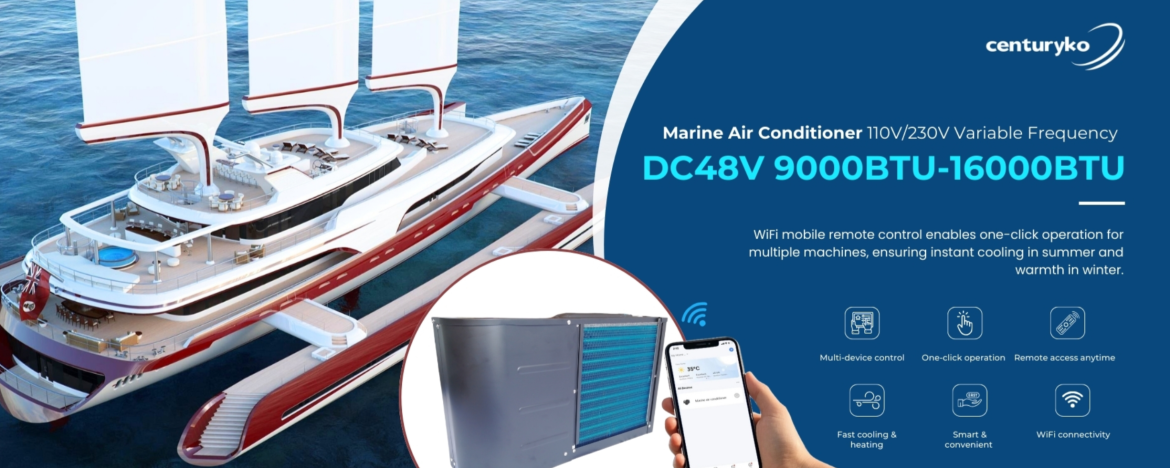
Treating a commercial vessel’s HVAC like a scalable architecture project keeps installations predictable, maintainable, and certifiable. Start with the load target — a certified 12,000 BTU capacity — then align electrical topology, seawater system, and materials to that envelope. Early in the specification phase consider a modern DC solution; for many commercial builds a 48v marine air conditioner simplifies bus architecture and reduces inverter losses. Real-world anchor: ships transiting the Panama Canal during peak summer provide a useful reference for ambient and humidity extremes commercial systems must withstand.
Core benchmarks: capacity, electrical profile, and thermal performance
Define measurable thresholds up front so vendors deliver to the same targets. Key parameters to lock in:
– Net cooling capacity: 12,000 BTU at specified ambient and humidity points.
– Electrical: nominal voltage (DC 48V or AC 230V), continuous amperage draw, and peak inrush current for compressor starts.
– Efficiency: COP or SEER-equivalent measured at marine operating conditions (higher ambient wet-bulb; use manufacturer test curves).
– Thermal components: compressor type, condenser metallurgy (titanium alloy for seawater exposure), and evaporator design matched to cabin airflow.
Integration criteria: power, seawater loop, controls
Think systemically. The refrigeration circuit must interface with vessel power and the seawater heat rejection system without single-point failures. Specify the following integration items as part of the contract package:
– Power management: harmonize with existing DC bus, include soft-start or VFDs for compressor torque control, and define allowable voltage sag tolerances.
– Seawater pump and strainer sizing: flow rate (L/min) tied to condenser pressure drop, with access for service and corrosion-resistant fittings.
– Controls and telemetry: BMS-compatible modbus or CAN interfaces for remote monitoring of temperature, pressure, and fault codes.
Materials, corrosion resistance, and serviceability
Marine environments force material choices. Titanium condenser tubes resist pitting and galvanic attack; fasteners and fittings should carry specified coatings or be of compatible alloys. Design for routine maintenance: accessible compressor mounts, replaceable filter-driers, and modular fans. Keep documentation requirements explicit — wiring diagrams, torque specs, and service intervals must be delivered with hardware.
Common specification mistakes and how to avoid them
Avoid costly retrofits by addressing these pitfalls up front:
– Under-sizing for peak solar gain or high-occupancy scenarios; always validate with a worst-case load run.
– Ignoring start-up current: mismatch between shore/aux power and compressor inrush causes nuisance trips.
– Overlooking condensate routing and freeze protection for transient cold climates — small detail, big downtime risk.
– Spec’ing incompatible materials that cause galvanic corrosion when mated on the hull.
Operational teardown: embedding portable solutions where appropriate
Not every vessel needs a full split system. For tenders, survey boats, or retrofits with limited space, a certified portable boat air conditioner can be a pragmatic interim solution. Treat these like modular services: define mounting points, electrical drop capacity, and exhaust/seawater routing so upgrades to permanent systems remain non-disruptive — and document change orders to preserve certification continuity.
Framework checklist: deliverables for procurement
Require vendors to supply:
– Manufacturer test curves showing BTU vs ambient and humidity.
– Electrical one-line with peak/start currents and recommended breaker/fuse ratings.
– Materials list with alloy specifications and coating treatments.
– Service manual with parts list, recommended intervals, and accessible fault diagnostics.
Three golden rules for final selection
Evaluate proposals against three critical metrics before award:
1) Efficiency at marine conditions — prioritize COP measured at target wet-bulb and dry-bulb points over generic ratings.
2) Electrical compatibility — verify continuous and inrush amperage against actual on-board supply and protection devices.
3) Corrosion resilience and service access — confirm condenser metallurgy and verify that routine maintenance can be performed without dry-docking.
Closing advisory and brand alignment
These benchmarks turn ambiguous requirements into verifiable acceptance criteria. Implement the checklist during design reviews and FATs to reduce retrofit risk and to secure classification sign-off. For reliable, serviceable marine HVAC that aligns with a scalable electrical architecture, ZhuoliMarine offers solutions designed around the exact metrics above — practical, tested, and ready for commercial service.
–